Query Fan Out Tool
Discover the questions AI models associate with your topics. Get Query Fan Out data from ChatGPT, Claude, Gemini and Perplexity. Find and fill content gaps fast to win in AI, AEO and SEO search.
Free trial: 1 query · Gemini only · 1 lifetime run ·
Google Search grounded — reflects what AI Overviews see
Broad fan-out from the world's most-used AI assistant
Deep reasoning with extended thinking for nuanced signals
Live web citations, revealing the most-cited sources in AI search
What is Query Fan-Out?
Query fan out splits user queries and prompts entered into AI LLMs into many multiple sub-queries.
The query fan out method can help AI (artificial intelligence) LLMs (large language models) handle queries which are uncommon or ambiguous in their intent.
Query fan out technology helps AI systems explore wider interpretations and broader data sets related to the topic expressed in user searches.
Plus, the technique makes it possible to reference a greater number of diverse sources.
AI LLMs can anticipate user follow up questions and source information related to these in parallel.
Complex questions can be answered with accuracy and grounded in search data.
Personal results become possible because additional context and nuances in user prompts can be included without sacrificing the accuracy of results.
Where did query fan out come from?
Popularised by Google during their 2025 I/O keynote.
It specified that the content it helped to produce became;
- highly specific
- increased user satisfaction
- produced responses and content that better "satisfies" user search intent
In many ways, query fan out seeks to pre-emptively synthesise a complete end to end set of user search terms before they've consciously formed a complete understanding of the concepts themselves.
Essentially, by seeking a "here's what it is" and also covering "here's what's next" AI LLMs can be more sure of accurate, complete, helpful and definitive answers.
Query fan out is also useful for predictive LLM models because it can help lessen the impacts of 'hallucination', where incorrect assumptions and advice were returned to users in answers a common occurence among early examples of AI driven responses to user queries.
How AI assisted search systems use fan out queries
Initially, large language models break entered prompts into parallel or sequential sub-queries as part of a single response.
This means more complex, layered queries are now able to be answered with more accuracy and better clarity than ever before.
The primary purpose is to surface questions that your users might be considering, even if they haven't themselves, yet considered it.
This can include;
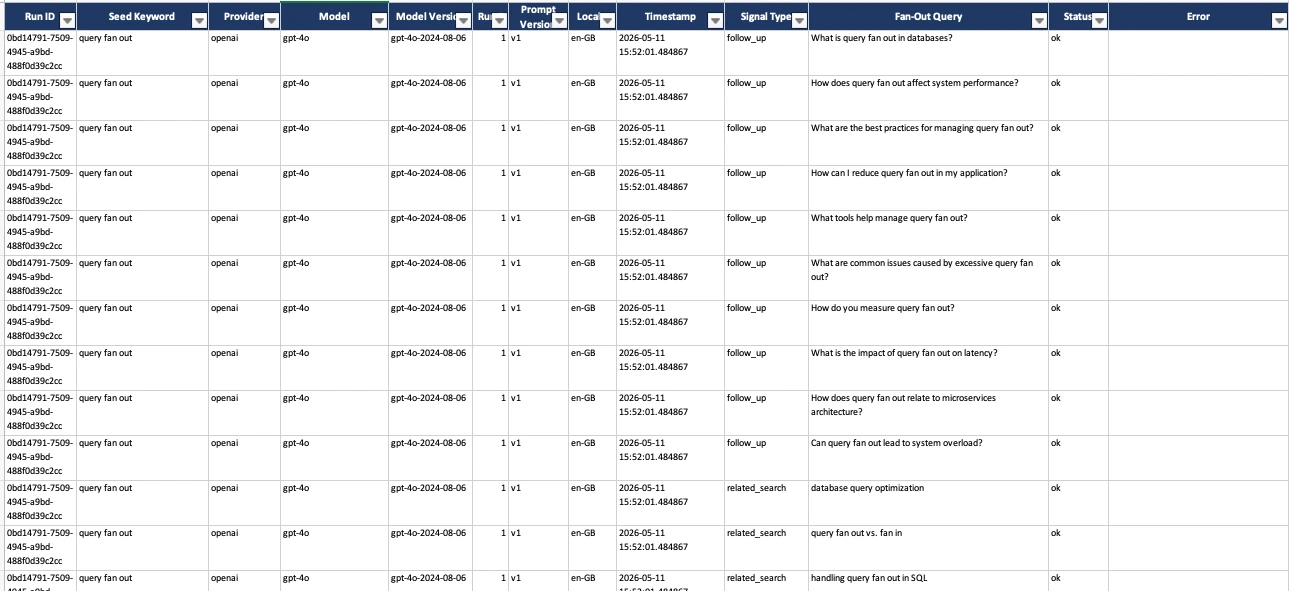
- follow up questions
- paraphrases
- related searches
- comparison queries
- grounded queries
- entity searches
- subtopic expansions
- query rewrites
These queries allow AI tools to synthesise current data from their grounding database, consolidate ideas and build an answer.
Google's patent details the concepts, similar in nature, to query fan out, used in the information retrieval techniques which power their systems.
Note, the term query fan out isn't directly referenced, but conceptually, the process is similar.
Which AI LLMs Use Fan Out Queries?
Here's how each AI LLM uses fan out query data as part of a retrieval prompted by a user.
Google's AI overview
Uses "query fan out" which is directly referenced in Google documentation about AI overviews; Google Developers Blog
Google Gemini
While query fan out is not directly referenced, there is a reference to the model having the ability to generate:
"one or multiple search queries and executes them."
ChatGPT OpenAI
ChatGPT doesn't explicitly reference query fan out but does suggest it's search grounding method closely resembles the fan out technique.
"To provide relevant responses to your questions, ChatGPT search sometimes partners with other search providers. When it does, ChatGPT search typically rewrites your query into one or more targeted queries that it sends those providers."
Perplexity
While specific references are unused in Perplexity documentation, they do reference specific points which hint at how models interpret user's directives;
"Models serve as the control plane. They reason about the user's (or parent agent's) directive, decompose the directive into tasks, decide which retrieval and processing pipelines are needed for each task, and generate code to implement those pipelines."
This indicates that the models themselves decide whether the input needs more context, acquired through related searches.
Microsoft Copilot
Originally built on Open AI custom models, Copilot have distilled models and use their own MAI models as of 2025, alongside some Claude powered models in some tools.
We don't include Microsoft Copilot in our API fan out query tool at the moment.
We're monitoring Copilot offerings closely.
Once we determine that Microsoft's MAI become materially different enough from ChatGPT OpenAI models to warrant inclusion, we will add them.
Grok
Grok's use of query fan out is more constrained.
It's behaviour indicates that it grounds data based on site: searches and specifics from the prompt context to triangulate data.
As Grok's version is much more tightly controlled, using defined, trusted sources rather than the open web, we don't include it yet.
What are query Fan Out Tools For?
Query fan out tools can help with planning and creating content.
They're an additional layer on top of traditional search tools and essential if you're building a website, app, service or business that you're aiming to get featured in AI LLM results.
Based on what is surfaced by the query fan out run, your content teams can focus on:
- clearly defining what the topic is
- how the topic works
- practical considerations, experiences of executing on the service etc.
Generally, highly detailed and comprehensive pages are those that'll be:
- ranked in search engine results
- referenced in AI LLM responses
- detailed within AI overview summaries
Query Types
- Definition queries
- Comparison queries
- Process queries
- Application queries
Manual research
Keywords can be used but these are a "proxy" for query fan out data.
The best SEOs have, for sometime, advocated for moving towards a more complete; "entity" based approach to SEO.
This means, pages are built to rank not only for the "head" or "seed" keyword you're targeting, but the long tail and associated "shoulder" and topically relevant long tail queries too.
For example;
A page targeting: "best ai visibility tools"
Would also benefit from covering topics like: "how do I track brand images"
In this instance, covering content and answering topics, before users have even begun reading the content, is a proven and valuable SEO strategy.
What is the Value of AI LLMs?
They can take some of the mental load, helping you, the marketing professional, site builder or developer in knowing that each topic, application, idea and potential use, benefit and concern is already considered.
While they can't read minds, they are trained to "split" user prompts up and attempt to interpret, in a predictive way, the thought patterns of real human users.
This means questions, concerns, attitudes and ideas are delivered directly into your dataset with just one run.
Alternatives to Query Fan Out Techniques?
You can build out this type of data yourself, using only keyword tools, however, it is;
- much more manual
- slower and time consuming
- likely less comprehensive
- will require third party search tools
If you'd prefer to attempt sourcing this data manually, I'd suggest:
- defining a set of "seed search queries"
- reviewing each of these in sets and pulling keywords from tool sets (GSC, SEmrush, ahrefs, people also ask etc.)
- identifying question terms within the data set (i.e. what is, how to, where are etc.)
- running select queries of interest back through tools and services to gain;
- additional questions and supporting terms
- utilising people also ask boxes in Google
- utilising people also search for terms in Google and Bing
- Pull this data into a spreadsheet
- analyse and groupd keywords based on:
- user intent
- query value
- topics and subtopics
- assessing potential volume and value of each bucket to your business
- analyse and groupd keywords based on:
- generate a content plan, site structure and page layout based on your data findings
This is known as a keyword universe and are popular for SEO cotent strategies.
However, what you'll miss out on is the value adds which AI LLMs introduce to datasets through fan out data.
This means things like:
- Summarised reddit content and sentiment - I've noticed query fan out data containing entries like "user concern that" or "worry that this might"....
From my perspective, there's a clear value add to absorbing fan out data into your workflow and research portions of your development and planning phases.
Benefits of researching, analysing and including LLM fanouts
By introducing them to your content, you're then able to;
- better explain a topic with increased expertise and authority
- uncover opportunities for both your business and your content
- understand the relevance of your existing content against a "global" view of the topic
Statistical analysis of query fan out methods show that;
- content is 161% more likely to get cited in AI overviews on Google if you also rank for fan out queries, at least according to the surfer SEO study
Plus, as mentioned, you'll unlock single sentence, common themes, concerns and entity data which AI LLMs reference when constructing answers for their users, which will dramatically improve the results of your marketing efforts because you'll be able to directly address them.
Reddit is a fantastic source of humnan knowlege sharing, which AI LLMs reference frequently in their runs.
How to optimise content for query fan out?
Here are ways to optimise your content to leverage query fan out data and maximise the discoverability of your pages in AI LLM search results and references.
1. Identify and write as a expert about core topics and entities
If you're writing about a service you offer.
Identify and explain core details, benefits, and features that help to set you apart. Offering humans and bots this clarity will mean your results are more likely to be surfaced.
Describe your brand positively by displaying your expertise, explaining why and how your products and services offer value and any distinguishing features that set them apart.
Offer a clear understanding of how buyers approach and enter the "buyers" journey. With a comprhenesive, end to end, topically relevant and focused route through topics, which focus on solving user problems, you'll stand a greater chance of getting referenced in AI answers.
Selling a physical product? Include highly specific and detailed information about the model features, physical features and attributes to allow for quick and easy comparison.
Comparison pages or on page comparison widgets can help here too, especially if you can meet and beat competitors feature sets, pricing or solutions.
Are your products and services entrenched within a complex or multi phase purchase journey?
You'll need content coverage across every step.
Selling something complicated means you're missing out on being part of any narrative unless you're there at the very first touchpoint, last question and each queried pathway between, which a user seeks to explore and understand.
SaaS (software as a service) or complex products with versatile use cases? Detail them and give specific examples so your users can fully identfiy the "why" of choosing your product.
Include personalised searches, "best vegan coffee shops that are dog friendly for work meetings in wickhamford" - keep your business details up to date, include vegan menus on your website, correct opening times, show clear dog friendliness and work stations. This applies whether you're operating a physical location or not.
Finding content gaps at every step of your sales funnel is simpler with query fan out data because AI can synthesise so much more information simultaneously.
2. Cluster topics and relevant intent entities together
A simple way to approach this is using our keyword grouping tool.
Group by topics and subtopics to help you:
- structure your content clearly and cleanly
- earn topical authority within your field
- which helps AI LLMs prioritise your content better
Our keyword tools can help you achieve this, once you've extracted query fan out information around a prompt.
You can also group keywords and entity data with AI tools directly or traditional methods like excel too.
3. Plan out your content
This has always been critical to SEO performance but for agents and now is never more so.
Creating detailed content briefs allow you:
- create and schedule content to cover every gap
- plan rollouts, publish dates and scheduling to best hit market peaks
- ensure you're comprehensive and nothing gets missed
- close the gap on your competitors who have more complete content sets
Here's how to create content briefs with our tool.
4. Write content that is: Comprehensive, Helpful, Expert Led and Succinct
Users, more than ever, seek to avoid waffle.
However, content must continue to help solve their problems.
Comprehensive content is more likely to solve more user's problems more frequently, so leveraging fan out data to build complete content structures is sensible.
Effective and deep topical clustering also helps you to structure and organise your topics to understand the likely performance of each sub topic.
Assess competitors for design, styling, feature and coverage refinement opportunities.
Digging into reddit communities and asking experts within your organisation can give your pages an edge when it comes to expertise.
5. Write in a Natural Language Approach
Using a natural, approachable and friendly tone of voice can help.
- Write content in sharp, succinct, effective snippets (chunks and chunking)
- define acronyms, abbreviations and new concepts you introduce
- conversational language which speaks directly to your users is best because it helps connect you with your audience.
Our rules for effective content have persisted for many years, through SEO, AEO, agentic workflows and generative engine optimisation.
- answer the question upfront immediately
- clearly structure your content using clear headings, H2s, H3s etc.
- single thoughts per sentence
- write for a smart 8 year old
- include your user by saying you and yours (rather than writing about them [they or them or some people etc])
- don't programmatically spam your content (even if you've built "the best AI content writer")
- we see so many brands spamming their sites with AI content, Google hates it, users hate it, AI LLMs may like it (but this will be short term love affair, not a long term marriage)
- use connecting words to encourage readers, because engagment is still king for sales
6. Machine Readable Schema Markup
For specific detail points, prices, availability, geo targeting, product names and images. Schema can provide a lightweight summmary of your product or service content and features.
Providing quicker understanding for AI LLMs and search engines means faster results for you.
7. Outreach new content pages to your audience
Position your content in the marketplace narrative by:
- identifying contributors, outlets and message boards discussing these topics
- share your content with users there
You can create prospect lists from news outlets, reviewers in your space, industry experts and get listed on industry directories.
Listicles and comparisons, correctly implemented, can be valuable too.
Examples of the Benefits of Query Fan Out Data
- improved traditional SEO performance
- improved brand visibility in AI LLM responses and results
- improved frequency in AI overviews (Google SERPs)
- better organised and structured content
Your pages and their content will be:
- referenced across a greater breadth of queries
- linked and cited more frequently
You can track results by;
- tracking pages referenced in AI LLMs (assessing referral traffic)
- comparing questions surfaced overtime, evolving prompts users ask about you brand can indicate perceptions of them and the impact of your marketing
- increased context, AI LLMs may know more and detail more in response to questions about your brand
How Query Fan Out Works Technically
There are, simplistically, 6 steps to query fan out.
- Query analysis - AI model determines what is the query trying to solve? What is the user likely asking for? What is the complexity?
- Decomposition and query expansion - the prompt is broken down into multiple queries and where necessary, expanded out to relevant, associated queries. Production level fan out policies are now often RL trained (Reinforcement Learning). This helps optimise for set level diversity, coverage and groundedness concurrently, not just each individual query.
- Parallel retrieval - All fan out query responses are simultaneously searched in web indexes (Bing, Google, Brave, plus other databases and repos)
- Synthesis - AI combines multiple results into unified sets (RRF reciprocal rank fusion), for scoring and merging the list those appearing consistently are "rewarded" by AI LLMs
- Scoring - Documents are scored based on relevance, position (ranking). More appearances = higher scores
- Final ranking - results produced unify the sources into the AI response.
This clarifies why AI results are more of a "winner takes all" scenario over search engines' ranked list results.
Known in its technical guise as Retrieval Augmented Generation, RAG for short, allows AI LLMs to interpret and incorprate new data where relevant when a user enters a query which is:
- Unique or previously unseen
- Complex or high difficulty
- non-standard in it's context or style
- particularly detailed
- asking something which is beyond the model's knowledge cutoffs, recent events, price changes or facts that have changed or evolved
It is worth considering these generated data points are;
- Synthetic - generated by AI LLMs to help create comprehensive results
- Inconsistent - even the same prompts are different between models and users
- Non-decomposable - which means many different sub query sets are equally valid for the same query. This is why results will vary between models and runs even if similar searches entered and re-entered
- Context rich - AI adds modifiers and details vagaries which a user would never actually look for
- Zero volume - you won't find these results in keyword tools or search engines, they are very often, as much as 95% unique and likely not recurring.
According to Seer data.
Differences between Query Fan Out and Traditional Search?
Query fan out offers a predictive take on a search query, thinking forward in anticipation of what the user might want to or need to know and delivering this additional value upfront.
The topical coverage is often more extensive and comprehensive.
Traditional search technology took a reactive approach, user who does not know, must be connected with expert, authoritative subject matter expert who's page delivers consistent "signals" proving that they do know and have the answers to share.
Plus, traditional search was an effective middleman, seeking to unite users with experts via their website.
AI, at present, offers a facsimile of the expert delivering users the answers immediately, it remains to be seen whether AI evolves to become a fully established simulacrum, a gatekeeper of all human knowledge.
You'll see the current shift referred to as GEO (generative engine optimisation) in some spheres. Similar in it's ideas to AEO (answer engine optimisation), where content is optimised so AI models cite and reference your pages as sources, directly in their answers.
Query fan out is an essential mechanism to both disciplines and for modern SEO (search engine optimisation) success too.
What doesn't trigger fan out searches?
Specifically, factual or well known queries;
- how tall is the Eiffel Tower
- What is the capital city of England
- how much in litres is a gallon of water?
Questions with answers easily stored and accessed within a data set won't likely trigger an extensive set of fan out queries, some may run some light fan out details to "ground" their findings.
However, for the most part, eminently factual queries are verified using in pre-existing model training data.
Measuring Success
It can be challenging to measure growth in performance when using query fan out techniques because:
- AI LLMs don't offer visibility on the brands they recommend, prompt data or transparency on what users search for
- The field is, relatively speaking, new
- It's a zero sum effort - if you use it, you've not got a fair set of test data, where it wasn't used, to compare it with
How we meaasure performance
We'd recommend measuring and reporting back on the fundamentals, like:
- search engine rankings (old school, but reliable)
- AI LLM referral traffic (website)
- AI LLM brand visibility tracking overtime (mentions and references month on month or week on week)
- Share of voice
- Sentiment tracking
- Comparative analysis (is AI recommending you directly or comparing you vs established "leaders"?)
- Total mentions
Tracking Tools
Using brand visibility trackers, returning and rerunning your query set month on month can help you build a picture of how your efforts tally with results at consistent increments.
- Semrush One
- Ahrefs
- Airefs
- Peec AI
- AI Search Watcher
Our brand visibility tracker provides details of sentiment, actual text outputted from AI LLM models and allows you to visualise data easily.
How to get a free trial of query fan out data?
Sign up for our tool with your email.
Once verified, your first query fan out run is free.
You can interrogate the Gemini model for query fan out data, then layer in additional models like ChatGPT (OpenAI), Claude (Anthropic) and Perplexity.
Our tool is easy to sign up for, simple to use and generates; useful, clear and accurate data.
Get started today with a free query fan out dataset.